



As part of this issue’s Special Feature on Sustainability in Retail: A New Standard, Ámbar Margarida, Principal at the architecture and interior design firm Spacesmith, reflects on a new design ethos for conscious luxury and what it means for the future of sustainability in retail.
Sustainability in retail can take many forms – from a circular approach to global supply chains, all the way down to the selection of finishes, fixtures and construction methods that define a new boutique. And despite what the ubiquity of online shopping might lead us to believe, a growing number of consumers today are wary of waste attentive to provenance and alert to the environmental cost of a disposable mindset. This shift is fuelled not only by mainstream reporting on retail overproduction (from Vogue Business to The Business of Fashion) but also by widely circulated investigations into global waste streams, including the Atacama Desert textile-waste crisis covered by The New York Times, BBC and Al Jazeera.
What is becoming equally visible – especially to luxury brands investing in new stores – is the environmental toll of the built environment itself. In the US, construction and demolition (C&D) waste totals over 600 million tonnes annually, according to the EPA, with more than 90 per cent stemming from demolition alone. To put that in perspective: the C&D waste sector generates nearly double the municipal solid waste produced by all US households combined. For retail, where frequent refresh cycles and global rollouts are the norm, this underscores an uncomfortable truth: material turnover in physical environments contributes as much to the waste conversation as product overproduction.
In this context, true luxury is about longevity – spaces and objects crafted to endure in both form and function. A store built with timeless materials and adaptable design will hold its value and beauty far beyond seasonal trends. Embracing this architectural ethos – one that honours durability, craft and environmental responsibility – is increasingly both good practice and good business for retail brands. And today’s luxury consumers are meeting that ethos with rising expectations of their own: they now look for transparency, longevity and investment-grade craftsmanship in every touchpoint, from the products they purchase to the environments in which they encounter them. As a result, the definition of “conscious luxury” is expanding beyond sustainably sourced materials and ethical supply chains to include store environments that are built to last, designed for flexibility and conceived with the full lifecycle of materials in mind. Increasingly, this also means valuing what already exists – repurposing architectural bones, retaining high-quality finishes and reimagining spaces rather than defaulting to demolition. In luxury retail, the ability to transform rather than replace is becoming a mark of both environmental intelligence and refined design.
In terms of sustainable retail design, it may also seem counterintuitive that the luxury segment is setting the key precedents. But it shouldn’t be surprising – after all, luxury brands big and small are built on values like longevity, durability, reuse and reconditioning. These are the considerations that explicitly influenced Hermès to develop its internal Harmonie real estate sustainability standard in 2021, to address environmental, social and corporate performance criteria across Hermès’ real-estate portfolio. As part of this sustainability standard, the company opened in 2023 Maroquinerie de Louviers, a sustainable, energy-positive workshop, which met the five assessment criteria of the Harmonie standard. What’s compelling is that Harmonie is not a marketing exercise – it is a design and operations framework that approaches sustainability with real rigour. It considers the impacts of climate change on a store’s location – whether related to flooding, heat waves, or broader environmental stresses – and incorporates those risks into long-term planning. It prioritises durable, reparable materials with lower embodied carbon and it requires project teams to embed sustainable decision-making from the very first concept sketches.
Many of the best practices luxury brands employ offer useful lessons for retail design leaders. For example, we often see luxury clients invest in durable materials and details that can be maintained or refinished over time, rather than replaced, such as solid wood instead of wood veneer in high traffic areas. Selecting materials with an eye towards longevity brings long-range cost benefits and crucially, by employing modular and prefabricated construction methods, retailers can use high-quality materials without having to rely on expensive onsite fabrication that is specific to every individual store. In our experience, luxury brands are increasingly turning to these prefabricated solutions as a means of reducing construction waste while ensuring uniform standards of excellence and quality control.
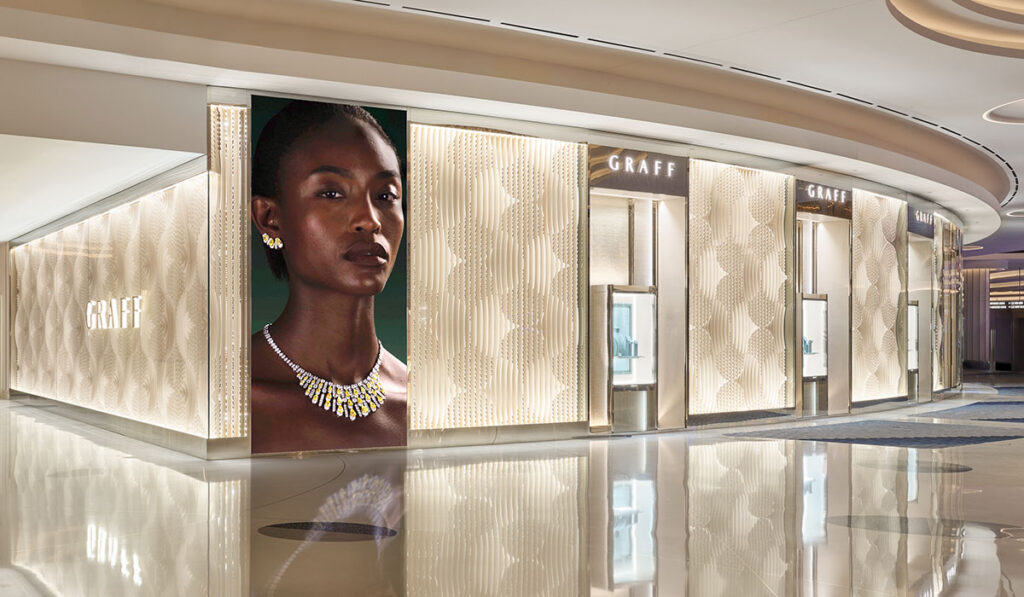
A similar ethos of reuse also informs the way sustainability-minded luxury brands approach the process of taking over existing retail space to create their own boutiques. Instead of stripping back to the studs and starting from scratch, the goal is to reduce waste and preserve as much of the existing space as possible while layering in the essential brand elements. This approach not only prevents high-quality materials from ending up in landfills, it also honours the craftsmanship already embedded in a space and extends the life of components that still have value.
Credit: Jonathan Hökklo
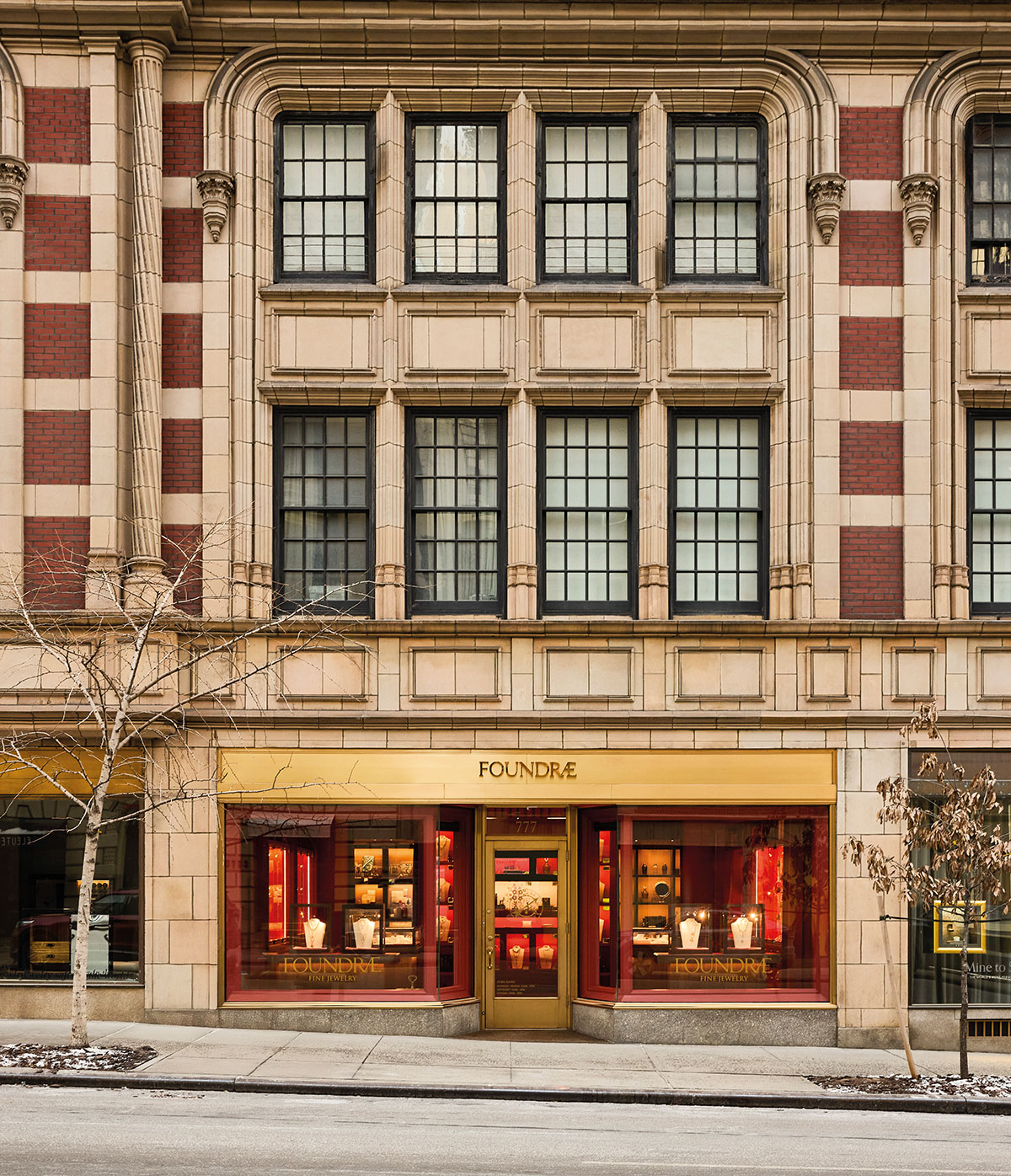
In practice, this often comes down to a combination of creativity and restraint. For example, a boutique fine-jewellery client recently moved into a former high-end shoe store where many of the existing architectural elements were beautifully made. Instead of demolishing them, only selective portions of the custom millwork were removed to make room for secure jewellery cases, while the remaining flat panels were retained and integrated into the new composition. The previous tenant’s backlit ceiling system was also reimagined: its lightbox structure stayed in place and only the fabric surface was replaced – this time featuring the jewellery brand’s symbolic motifs.
In another project, walls, ceilings and their associated mechanical and fire-protection infrastructure were kept completely intact. The design challenge became not how to erase those conditions, but how to work with them – ultimately resulting in a space that felt intentional, coherent and distinctive. The success of that project underscored a simple truth: when we treat existing conditions as a design asset rather than a barrier, more sustainable outcomes become possible.
For architects and designers, this shift doesn’t require perfection – just mindset, curiosity and a willingness to see potential in what’s already there. Even one thoughtful intervention in a project can meaningfully reduce waste and set a precedent for a more responsible way of building.
These strategies, or similar solutions, can help retailers integrate sustainability in an authentic, thoughtful way that is true to their brands and messages a serious business commitment to sustainability goals. To design sustainably is, in fact, to design luxuriously – with reverence for what is rare, well-made and enduring. These are not opposing ideals but intertwined truths. The future of luxury is responsible, rooted and purposeful – and the spaces that express it will stand the test of time.
