


Page 48 - #184 September 2023
P. 48
VOYAGER - INDIA

                                 Adapting to the Industry


              Retail brands around the world are today eager to participate in India’s growth as the fifth-largest retail
              market in the world. These retailers are eyeing up space in the large upcoming pipeline of Indian retail
              real estate developments as the country continues to grow and become a major player in the industry. Over
              the coming pages RLI takes a closer look at the retail market and a selection of ground-breaking schemes.

                      rban  Indian  consumers  have  increasing  purchasing  power   Food & beverage and a few entertainment brands are also expected
                      and branded goods in sectors including apparel, cosmetics,   to establish a presence in the Indian market in 2023, with chains such as
               Ufootwear, watches, beverages, food and even jewellery is   Lavazza and Armani Caffe of Italy, Jamba of the US and The Coffee Club
              steadily growing in popularity for usage in both work and leisure.  from Australia likely to enter this year.
                As the corporates – the Piramals, the Tatas, the Rahejas, ITC,   With the economy successfully rebounding from the pandemic and its
              S.Kumar’s, RPG Enterprises and mega retailers -  Crosswords,   after-effects, Indian consumers have hit the markets. From clothing to
              Shopper’s  Stop  and  Pantaloons race to revolutionise the retailing   accessories, food to beverages, premium is the dominant word on the
              sector, retail as an industry in India is coming alive.  retail horizon. Both e-commerce and traditional retail players are vying
                The market after 2021 has been an eye-opening time for the Indian   for a piece of the pie. The growth of the industry is driven by increased
              retail sector. The industry saw a decline of 8.5 per cent in FY 2021, but   consumer demands, disposable income, efficient logistics and advanced
              this quickly recovered in 2022 to reach $836bn with a contribution of   technology. Modern retailing has entered the retail market in India in the
              81.5 per cent from traditional retail.                form of shopping centres, multiplex malls and complex buildings that
                According to Kearney Research, India’s retail industry is projected to   provide shopping, dining and entertainment under one roof.
              grow to $1.407bn by 2026 and more than $1.8trn by 2030, albeit Deloitte   The mall of the future is less retail and more content, more social and
              India projects online retail to outpace offline growth by 2030 with online   more experiential. There is an opportunity to reinvent the mall experience
              retail penetration projected to grow at an extraordinary rate, outpacing   and bring people together in a way that encourages connection, functioning
              offline retail two and a half times over. Meanwhile, according to CBRE,   as the heart and central gathering place for the community.
              retail leasing is expected to reach 5.5-6 million square feet in 2023, the
              highest since the pre-pandemic peak of 6.8 million square feet in 2019.
                India will soon get bigger malls that will also make room for
              entertainment and services beyond shopping. With malls set to
              become 30-40 per cent bigger, the newer models of service should
              not be a problem as the malls that will come up in India will kind
              of resemble those in Dubai and the US. Leading mall developers,
              including Prestige, Phoenix, DLF, Lulu and Unity, have planned malls
              that will spread over more than one million square feet, instead of the
              more normal 500,000-700,000sq ft leasable area. Malls are not seen
              just as shopping centres and bigger mall spaces could help change their
              perception as family centres.
                More than a dozen international brands, including Valentino, McLaren
              and Balenciaga have debuted in India in recent months, seeking to take
              advantage  of  greater  demand  for  upscale  labels  since  the  Covid-19
              lockdowns. Others that have come to market include Pottery Barn,
              Pret A Manger, Tim Hortons and Popeyes. Elsewhere on the retail
              front, Aditya Birla Fashion and Retail Ltd and Galeries Lafayette
              recently partnered to launch upscale department stores and a specific
              e-commerce platform in India.


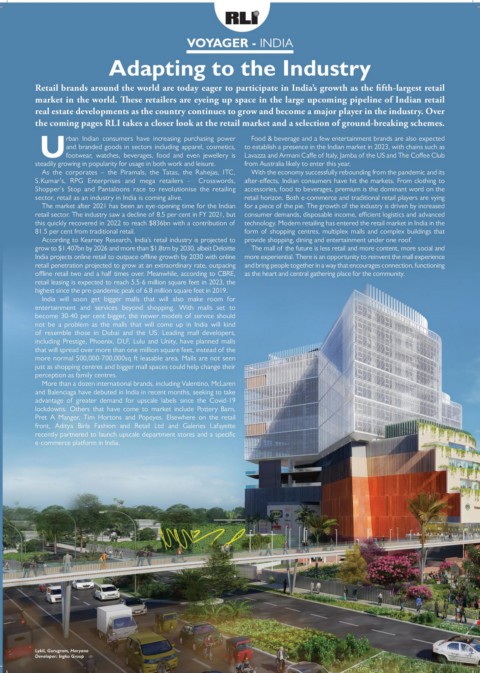
              Lykli, Gurugram, Haryana
              Developer: Ingka Group

