


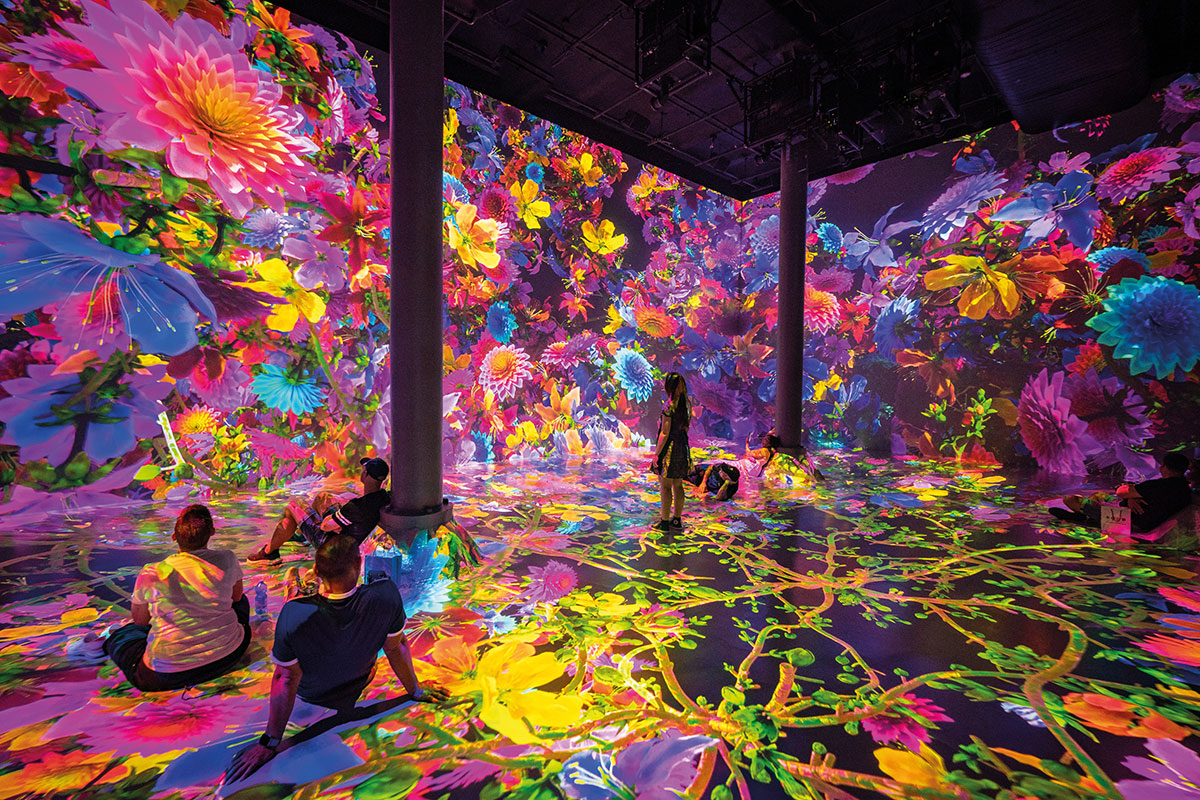

In our final Leisure Insight of 2025, Michael Mascioni, author of the recently released book, ‘Expanding the Immersive Landscape in Leisure Facilities’, discusses with us the changes that are taking place across the immersive location-based entertainment (LBE) landscape.
The location-based immersive entertainment market is undergoing major transformation and expansion, as diverse key creative, technological and business elements converge. The market is far more variegated and multi-layered now, encompassing a wider spectrum of experiences.
One of the most significant trends in this area is the development of a more robust infrastructure for immersive location-based entertainment utilising new technologies, such as AR and VR. Greater software and hardware tools are available to attract developers, producers and creative people involved with emerging forms of immersive location-based entertainment. Those tools include XRoam’s LBVR software and Niantic’s Spatial Positioning system. The recent launch of the LEXRA Association has also helped support the development of the location-based XR market.
Major venues for new forms of immersive location-based entertainment are expanding in scope. AREA15 has expanded its immersive offerings and Meow Wolf has opened a greater number of diverse venues. The establishment of immersive entertainment districts in Las Vegas and London has helped forge a stronger identity for the industry and provided a key boost for the industry.
Distribution for emerging forms of immersive location-based entertainment has improved to a limited degree through techniques like strategic partnerships, but new models of distribution need to be fully explored and implemented.
Hybrid immersive entertainment experiences have become more common, combining escape games with immersive theatre, or blending immersive art and immersive theatre, for example. Some of the most successful hybrid immersive entertainment experiences are the productions of Strange Bird Immersive, which incorporates immersive theatre in their escape rooms. Other hybrid immersive entertainment experiences include those offered in Atlas 9’s interactive arts space, which fuses immersive art, immersive theatre and games and FuzionGamz’s immersive game experiences, which blend “laser tag, escape game experiences and video games”.
Immersive art and science venues in particular, have expanded to encompass new topics and content forms, including balloon art/sculptures, mindfulness, yoga, magic, etc., such as the Balloon Story and the Museum of Illusions.
Immersive live theatre has become increasingly gamified, as reflected in the immersive theatre pieces Accomplice the Show and The Bunker. The Bunker blends various games, including role playing games and tabletop games, with immersive theatre.
Free roam VR experiences have become more prevalent in leisure facilities, whilst more experimental and emerging immersive experiences utilising AR and VR have been increasingly combined with more standard, established immersive attractions, such as classic video arcade games. For example, the BEE VR Theme Park venue in Maine has taken this approach in order to cater to diverse audiences.
Ambient interactivity has had an increasing impact on immersive-location based entertainment. For example, a greater number of immersive entertainment experiences have been embedded in nature and aquatic environments.
New formats have also expanded opportunities for VR entertainment attractions and systems. For example, a containerised, mobile version of Paradrop VR’s Pod flying experience was introduced in Poland in July.
Mixed reality attractions combining physical and virtual experiences have become increasingly popular in amusement parks and other leisure facilities. A new model of mixed reality location-based entertainment advanced by Two Bit Circus involves the creation of “downloadable theme parks” that can be experienced at home or at local venues.
There has been an increasing emphasis on immersive experiences in leisure facilities affording physical interaction. For example, Activate Games centres offer such physical games as climbing and jumping and the Squid Game Experience incorporates such games as Tug-of-War and a stepping stones game.
Social location-based immersive experiences, especially those involving games, have gained in popularity and have added more collaborative elements to immersive location-based entertainment.
Such new immersive applications as immersive wellness are attracting greater attention and have the potential to become major factors in immersive location-based entertainment. One of the more advanced efforts in this area is the immersive spa Subversive, which is due to open in 2026 in Austin and will integrate immersive art, neuroscience and social bathing and will utilise video projection mapping, lasers and AI.
Use of technologies such as drones and haptic technology in location-based entertainment is growing and those technologies will soon become a much greater factor in immersive location-based entertainment.
AI is being increasingly integrated in immersive location-based entertainment experiences, appearing in such venues as amusement parks and museums.
In summary, immersive location-based entertainment has expanded and broadened in scope and many growth opportunities lie ahead.
