


In the final part of our shopfitting feature, Mark Landini, Creative Director of Landini Associates questions whether it’s time to reinvent physical shopping? In this article he argues that retailers have to want to do this and recognise the commitment required to do this.
The first step is the brief, the second a benign dictatorship to manage this change, the third experimentation, then finally resources to execute, unhindered by the “day to day”.
The best design briefs are less than one page long, the exceptional ones one or two sentences. This brevity is good because it clearly states an outcome (often financial) for our work.
It’s rare for great briefs to annunciate visual outcomes, but sometimes they do, assuming design is limited to style. Retailers are honest folk, but often so busy that they don’t have time to reflect and reinvent. But that’s where design can help, by challenging the fundamentals and asking all the dumb questions.
Perhaps this is why so many stores look (and operate) the same and why fashion stores differentiate with chandeliers and wallpaper, and supermarkets untiringly mimic Whole Foods.
Four years ago we were asked to help reinvent a mass-market fashion retailer in the face of global invaders like H&M, Uniqlo and Zara. We ignored their brief that asked for mid-floor flexibility, and built walls with fixed lighting, articulating collections, and VM’d centrally. No flexibility required, more stock on the floor, and resulting sales that continue to beat their nearest rivals by 400 per cent per square metre. The client needed to be brave to adopt our proposals but all we really did was rationally answer the brief by “Reinventing Normal”; applying common sense.

So what’s “Reinventing Normal”? Well, it’s a rational process that starts by articulating a desired outcome, then challenges whether history is the best way to achieve it.
When supermarkets were first introduced after the Great Depression no one minded queuing at checkouts, because things were so much cheaper when bought in bulk. But three generations later we “get it” – so is this really the best use of the shop’s entrance? We don’t think so. When we recently redesigned Esselunga, Italy’s oldest supermarket, we rotated this layout by 90 per cent, allocating payment to a cheaper space and replacing this with a glass box of production, previously hidden in multiple unseen places.
The prices didn’t change, but now the shop’s window expresses what Esselunga does best, which is making great-value fresh food. And by the way: if your on-site manufacturing teams are in one place, it’s more efficient.
We called our brief “Dimmi” (Italian for “show or tell me”). Once agreed, this one word drove everything thereafter. Like the fashion store, this challenged, then “Reinvented Normal” for supermarkets. But if you really think about it, it just makes sense.
Perhaps this terrible plague will encourage more retailers to challenge everything they do? To think about what they want to communicate to their audience and how best to do this, but I’m not too hopeful.
Global design agencies will continue to peddle unaffordable “Experiential” design, or whatever the latest trend is, and the big four management consultancies will still sell reports by the pound. My final example is Jurlique. A wonderful biodynamic Australian skin care “business” that, recently sold, wanted to expand globally but was considered too ugly by department stores around the world.
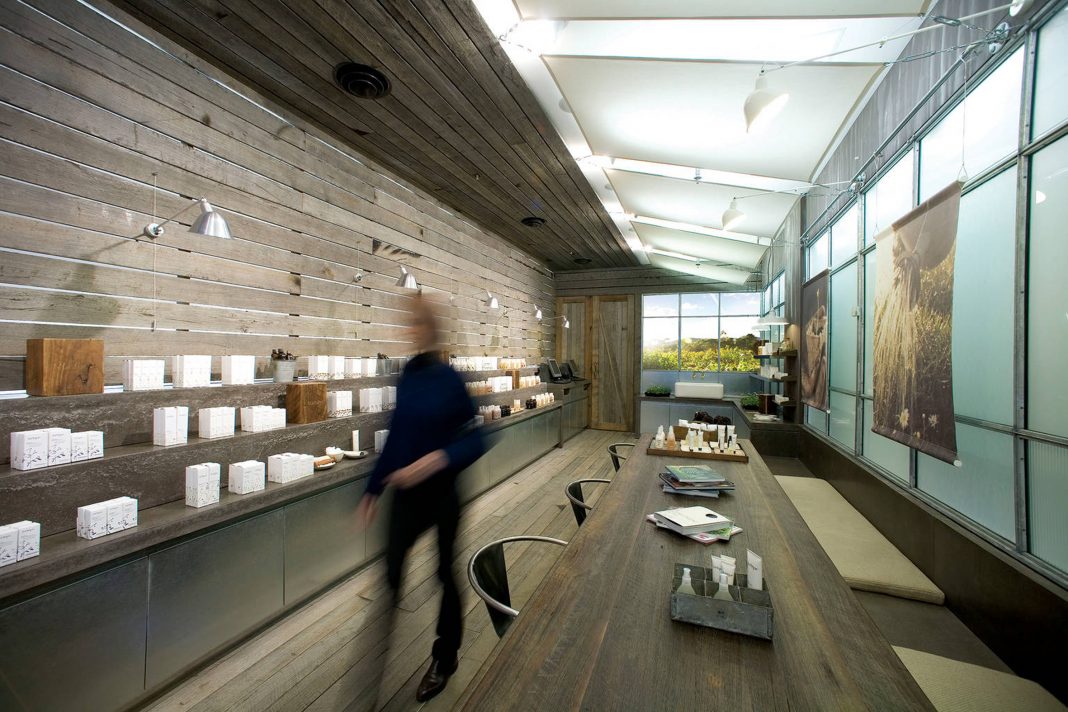
Management thought they should go more “mainstream”, mimic Clinique perhaps, but when commissioned we visited and marveled at the beauty of their farm in South Australia and challenged them to tell this story instead.

We re-packaged them with ugly un-flowered buds, and created environments that mimicked their potting sheds. It was brave but honest, and a few years later this “brand” was sold again for a multiple that must still make the founders weep. Why? Because whilst they always had an opinion, they were fearful of “normality” and the brand hadn’t expressed it. Now it does.
So, ultimately it’s all about the “questions” we ask and brave inquisitive minds are needed to ask if better than normal is necessarily best.
Think Mr. Selfridge and his incredible invention of Cosmetic Halls, or Amazon’s global dominance built in a nanosecond of some 10,000 days. They both think entirely about the customer and what might make their lives better. Working out how to implement is secondary, and just driven by the “mechanics” of our age.
Ultimately people shop, so it’s all about people. My Italian aunt went to the market three times a day, not to shop but to gossip and no amount of “Pop Ups” or “Experiential Retail” would have altered that.
And the online world cannot be replaced by them easily either. Uniqlo is genius, not only because of its value but because it mimics an online experience making it easy to find stuff, select and leave. ALDI does this too.
This is our new conditioning more than the need for a carousel ride. So, ask the right questions, keep it simple and Reinvent Normal.