


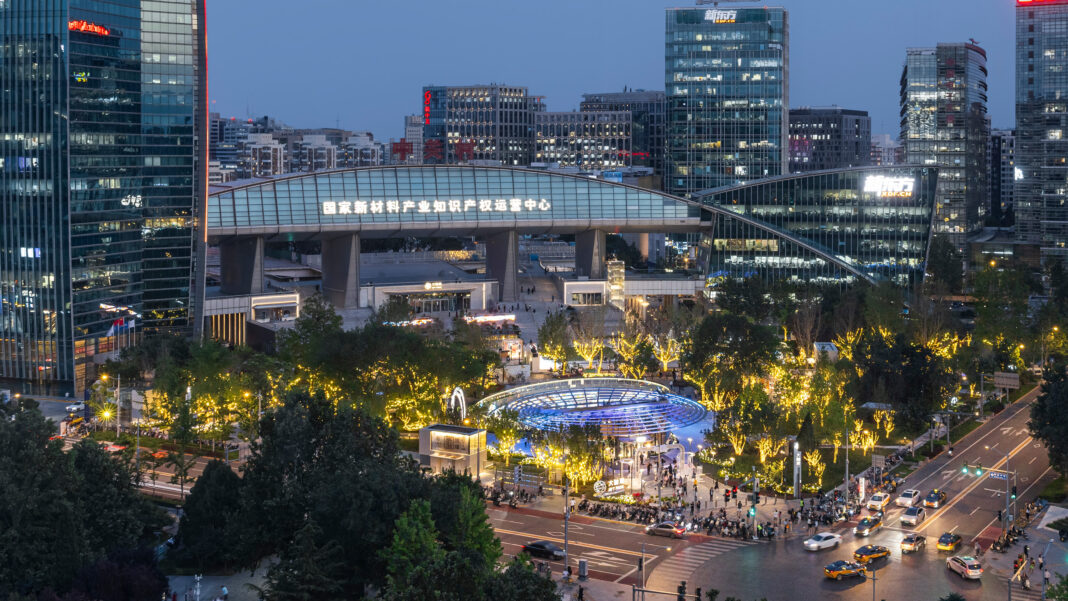
An emerging architecture and design firm based in Hong Kong, CAN Design, has completed the transformation of Zhongguancun ART Park, delivering both the masterplan and architectural design.
As one of the largest urban renewal projects within Beijing’s Fourth Ring Road and the city’s first large-scale Park-Oriented Development (POD) project, the design unlocks new possibilities for urban renewal while creating a next-generation urban sanctuary.
Zhongguancun, the birthplace of innovation and technology, is a district filled with vitality and energy. Known as China’s “Silicon Valley” since the emergence of the “Electronics Street” in the 1980s, the district has witnessed the rapid evolution of Beijing’s tech and commercial sectors, standing as a primary nexus for top universities and high-tech enterprises.
Located in Haidian District’s Zhongguancun innovation hub, the project revitalises the former Zhongguancun Shopping Plaza, Shibao Street and Carrefour site, reimagining the city’s collective memory into a modern lifestyle destination.
The brief called for a contemporary mixed-use destination that connects retail, public space and urban culture. Spanning approximately 125,000sq m across two distinct zones (East and West), the project integrates retail, ecology and leisure, elevating both consumer experience and the urban interface in Haidian.
Driven by a nuanced understanding of local character and demographic needs, the design focuses on a POD (Park-Oriented Development) framework. It fuses a three-dimensional spatial system: MALL + Open Street + Urban Park. Through the dynamic interplay between the East and West zones, it creates a layered and vibrant urban scene.
The West Area of Zhongguancun ART PARK Grand Mall features a sunken plaza-style themed precinct dedicated to culinary excellence. While the East Zone embraces a more open streetscape, introducing diverse lifestyle brands.
On a cultural level, the design honours Haidian’s heritage by preserving historic anchors, including the iconic double-helix sculpture, ancient trees and traditional temples. By tying spatial naming to historical narratives, the design translates memory into tangible cultural moments, giving the site a distinct sense of place.
