


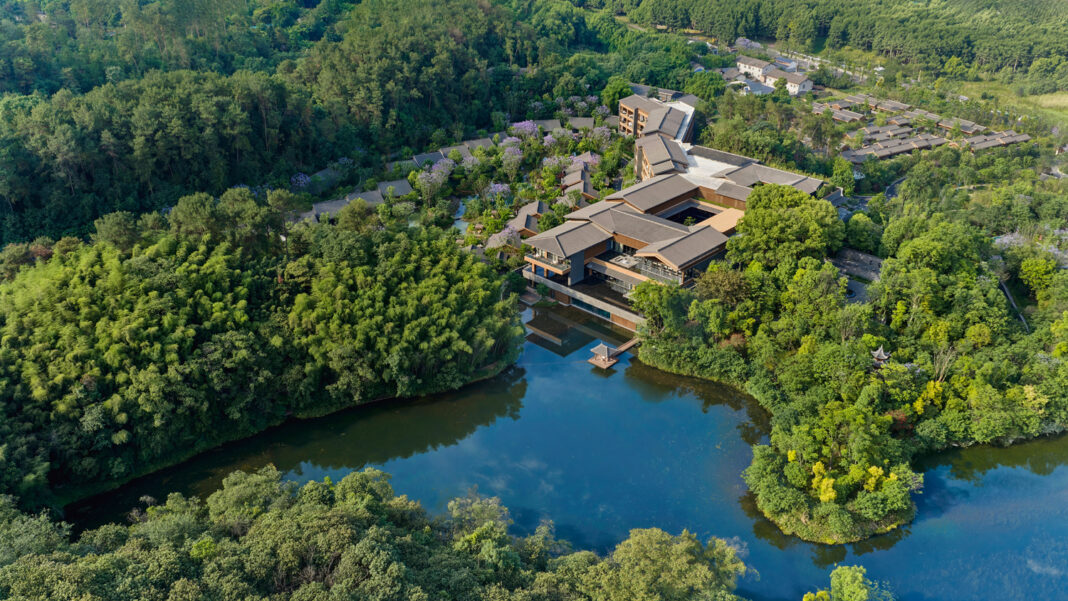
Nestled in the foothills of Mount Emei, the mountainside sanctuary offers access to one of China’s most revered landscapes, defined by mist-shrouded peaks, centuries-old temples and enduring traditions.
Banyan Group, an independent global hospitality company, has expanded the presence of its flagship Banyan Tree brand in China with the opening of Banyan Tree Mount Emei in China’s Sichuan Province. Nestled in the foothills of Mount Emei (also known as Emeishan), the resort serves as a gateway to the Mount Emei Scenic Area, part of a UNESCO World Heritage Site inscribed for both its cultural and natural significance and known for its rich biodiversity.
“Mount Emei holds a distinctive place in China’s cultural and natural heritage. As one of China’s Four Sacred Buddhist Mountains, it brings together centuries of tradition and exceptional ecological value. We look forward to welcoming guests to our mountainside sanctuary as they explore this important destination at an unhurried pace, moving beyond traditional sightseeing to engage more deeply with its landscape, living traditions and natural rhythms,” explains Philip Ding, Senior Vice President, Head of Hotel Operations, Northeast Asia and Business Development, China, Banyan Group.
Inspired by the traditional courtyard homes of western Sichuan, the resort reinterprets the region’s architecture in a contemporary form that follows the natural contours of a forested valley. Its design, landscaping and guest experiences draw on the surrounding environment and local culture.
During development, seven century-old camphor trees, together with all existing trees measuring more than 10 centimetres in trunk diameter, were retained in their original locations. Pathways through the bamboo forest follow the natural terrain, allowing bamboo to grow through and alongside the walkways while preserving the character of the site.
The guest arrival, framed by mature camphor trees, leads to an open-air courtyard inspired by the traditional Chinese architectural principle of “four waters returning to the hall” (si shui gui tang), in which pitched roofs channel rainwater into a central courtyard. Throughout the resort, filtered light, mountain air, the sound of water and views across bamboo groves and forested slopes create a quiet dialogue between architecture and nature.
The resort comprises 130 rooms and villas across six categories, each featuring a private outdoor hot spring pool. Mountain View Rooms frame the changing scenery across the seasons, Garden Villas open onto private gardens and one- and two-bedroom Lakeside Villas feature landscaped courtyards beside the water. The 320sq m Presidential Villa is complemented by a private garden of similar size and a terrace overlooking the forest and stream, providing greater privacy for families and small groups.
