


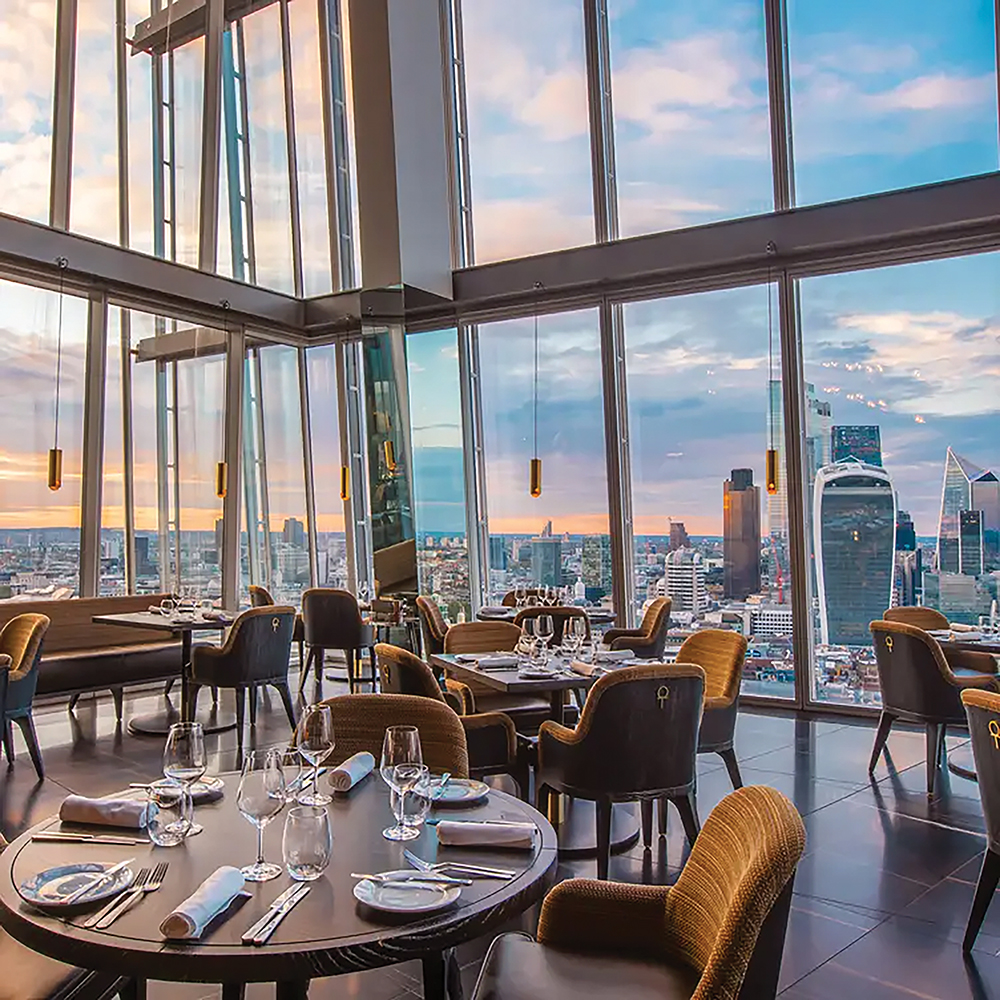

Jonathan Doughty is a global thought leader, consultant, speaker, moderator and C-suite executive in the foodservice and leisure sectors working around the world in retail, transit and leisure. This month, he focuses on why the concept of dining on rooftops rules and why it is a personal highlight of his.
I am focusing this month on one of my favourite subjects – why restaurants perched at the top of landmark buildings have become the most sought-after tables in town – and what they’re really selling beyond dinner. It is easy to look at the Middle East and wonder, but this trend started in the West and I have had the pleasure of working on several “top of the world experiences” including the first in London, Gary Rhodes with Rhodes Twenty Four at Tower42, all that time back in October 2003.
From London to Bangkok, the pull of altitude is undeniable. In Western Europe’s tallest building, Aqua Shard pairs contemporary British menus with floor-to-ceiling glass and 360° city panoramas; its very setting is the promise. In Paris, Les Ombres sits atop the Musée du Quai Branly; by day the Eiffel Tower casts a lace-shadow across the tables, by night it glows like a stage set – architecture as ambience. Bangkok has gone all-in on the skyline, with Mahanakhon’s SkyBar claiming Thailand’s highest dining perch and a connected rooftop experience that blends glass-floor thrills with cocktails and music. Now closed, this is being replaced by Ojo Bangkok soon. Singapore’s CÉ LA VI, straddling the 57th floor of Marina Bay Sands, is equal parts restaurant, skybar and club – an all-evening ecosystem rather than a single sitting. One of the projects I got the very most pleasure out of working on – one of a kind!
Closer to home, Berlin’s Käfer on the Reichstag roof folds civic history into the meal, while in Mexico City, Sofitel’s Cityzen frames Reforma and the Ángel de la Independencia like a postcard. Madrid’s boom in rooftops along Gran Vía – driven by social-media demand and heavyweight hotel groups – shows this is no fad; competition has even nudged cocktail prices down as operators add programming like outdoor cinema and brunch to stand out. And in Seoul, a tower-top n.GRILL turns the city’s nightscape into part of the tasting menu. All AMAZING places to eat and drink, but what is powering the ascent?
My five key take-outs are:
1. Views are the new “hero ingredient”.
The higher you go, the more the skyline becomes a signature in its own right. Operators know that a sightline – The Shard’s wraparound cityscape, the Eiffel Tower hovering at arm’s length, or Bangkok’s glass-floor vantage – creates instant differentiation that no ground-level fit-out can match. These vistas are also infinitely renewable: the same table serves a different mood at sunrise, sunset and after dark, which encourages repeat visits and premium pricing, the Nirvana for special places.
2. Sell an all-evening arc, not just a meal.
Top-floor venues increasingly function as vertical destinations: pre-dinner sundowners, a chef-led menu, a DJ-scored nightcap – often without leaving the building. CÉ LA VI’s configuration (restaurant, sky bar and club lounge) is a textbook example, engineered to catch guests at multiple dayparts. Bangkok’s SkyBar leans into DJ sets and signature cocktails; Madrid rooftops layer on seasonal experiences to keep locals engaged. The result is stronger dwell time and multiple revenue streams per guest, achieving unheard of revenue per guest numbers.
3. Iconic settings create cultural capital.
Some rooftops plug directly into their city’s story: dining on the Reichstag roof fuses cuisine with democratic symbolism; Cityzen frames Mexico City’s civic axis; Les Ombres is literally designed around the Eiffel Tower. These addresses give restaurants an editorial hook, making them natural backdrops for media, brand collaborations and high-profile events. The cultural context becomes a marketing engine you can see from your table, powerful for any city or country.
4. Social platforms reward altitude.
Skyline shots are the ultimate UGC. Madrid’s rooftop surge maps neatly to Instagram/TikTok demand; operators there report a crowded field where competition has forced innovation on pricing and programming. The lesson for any capital city: photogenic sightlines are acquisition channels, but sustained success requires a reason to return including menus with identity, curator-led music, or distinctive service rituals and stand out spaces.
5. Seamless choreography beats single-note spectacle.
The best sky-high venues work because the experience is frictionless: elevator logistics, weatherproofing, glass and acoustics, wind management on terraces and a menu that travels well in high-capacity service. Aqua Shard’s polished, reservation-led model; the layered spaces at Marina Bay Sands and the guided access to Berlin’s Reichstag terrace all show how operations and architecture must align to turn a view into a viable business. These are machines, well oiled, well run and able to print money when running well.
For all their glamour, these restaurants win when they deliver substance at altitude. That’s why the world’s capitals keep building higher dining rooms: because in an attention economy, the horizon is the most compelling story a restaurant can tell – served nightly, weather permitting!
