

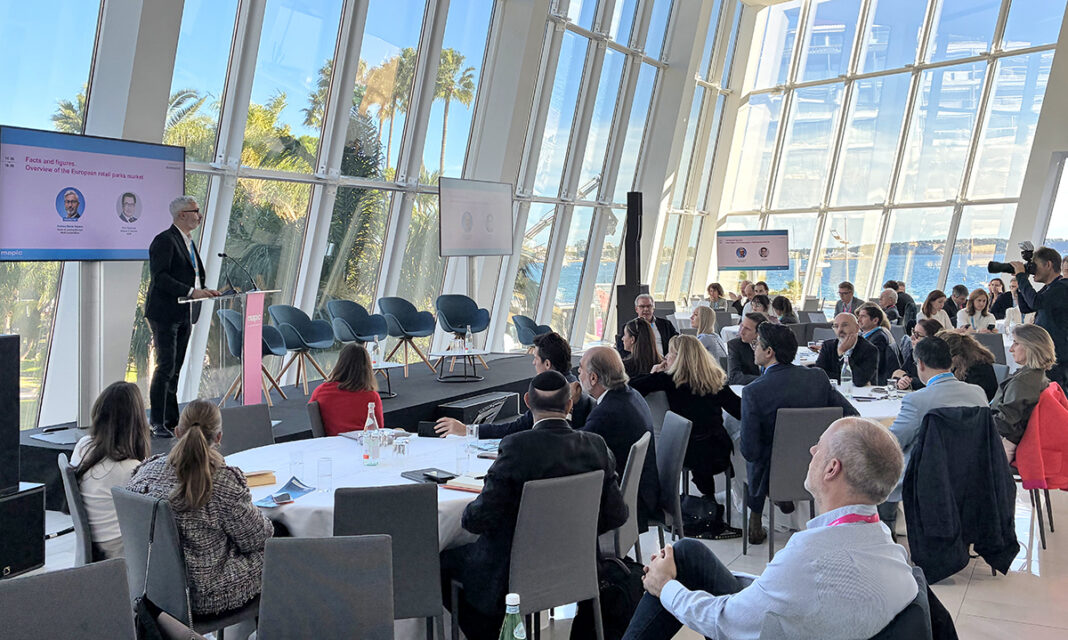
At the MAPIC Retail Parks Summit, it was all about the work involved in sustaining income. Here, Andrea Boris Hipeco, Head of Leasing Europe, Multi Corporation and Moderator of the MAPIC 2026 Retail Parks Summit, reflects on the questions he put to the investors and developers in Cannes.

The conversation had got to flowers. Antoine Frey explained how a change in the planting would reduce the cost of maintenance without in any way compromising the quality of the setting. Having gone through the acquisition, rent and return on investment discussion that might have seemed like a very minor point. It did though answer the question I’d put to the panel: at what point does your spend on the customer experience add value and at what point does it just make it more expensive to run?
That was the question that ran through the MAPIC Retail Parks Summit in Cannes on 3 November. On two separate panels, investors and developers were talking about different ways of owning and improving retail parks. Some were talking about the reliability of the income that you get from a retail park. Others were looking at changing the model altogether, bringing fashion, restaurants and leisure into the mix in places which were originally built around large stores and easy parking. The examples they gave were a good insight into the thinking behind those various approaches.
Buying income that will last
Ken Baccam of AEW set the scene by separating out income returns from capital growth. In his view income was absolutely central to the investment case for retail parks, capital growth on the other hand was something that had to be approached with considerably more caution. A very useful starting point for understanding what investors were really buying and what level of growth they should expect over the ownership period.
Séverine Maumy of Redevco took that debate right to the rent. The retailers obviously like the low rent and service charge structure. Her issue was whether that advantage and the income it generates would be sustainable. With greater competition for the acquisitions, the quality of the income and its sustainability were very much in the picture.
The geography was less straightforward. Roberto Limetti in Pradera saw potential in Italy and Poland. Germany was a more difficult call: the lower prices were an invitation to enter, but you had to take a view on the recovery. He conceded the risk of going into a market where the domestic investor was in the process of selling, while at the same time believing that Germany would be able to recover.
Limetti also drew the distinction between the steady income profile of a traditional park and a strategy predicated on rapid rental reversion. The investor’s view was of course crucial. A strong asset held over a number of years was a very different proposition to an asset which was an opportunity for quick rent uplift.
This prompted me to ask Alfonso Cuesta of M Core Spain the obvious question: apart from indexation and a potential shift in market yields, where would the additional value come from?
Growth inside the property
“It’s very difficult to capture rental growth beyond indexation,” Cuesta said. Long leases obviously limit the number of times you can reset the rent. Turnover is another route in principle, but as he pointed out the negotiated thresholds were typically way above the retailers’ trading targets and so didn’t provide any additional rent.
His reply was very pragmatic. EV charging, solar panels and advertising were all avenues for additional income. The space itself could be altered. There were some of the older Spanish parks which had been built for retailers who didn’t actually need the size of units that they’d been allocated. You could take the surplus space and let it out to other occupiers thereby increasing the income and the range of offerings.
The qualification was as important as the opportunity itself in that it was dependent on the individual property. Cuesta was very clear that you shouldn’t take an asset management opportunity you’d found in one acquisition and assume it was there in another.
Zakari Leriche of Accessite then brought it back to the end user. “Let me bring in the person who pays for all of it,” he said, naming the customer.
His examples were all about the connection between day to day management and the investor’s income. If you lose an anchor tenant you’ve got a cost. If you replace that tenant you’ve got a cost too. The owner has to look at both of those before they can decide which route is the one that’s going to protect the property. Splitting or merging units may attract a different type of occupier but you’ve still got to look at the rental opportunity that results against the work that’s required.
Leriche was very much in favour of the fundamentals: clean, safe, well looked after surroundings. The stores themselves had improved and the park around them needed to be up to the standard that customers would expect. You could have the most affordable prices in the world and still not be able to dispense with the need for care.
These contributions made the discussion of growth more specific. In the examples on stage, growth involved an identifiable change to the property or its operation. Sometimes the immediate task was to retain an important tenant. Elsewhere it was to recover space, adapt a unit or develop another source of revenue.
How much experience is worth paying for
The second panel took that discussion into more ambitious territory. With Antoine Frey from FREY and Philippe Journo from Compagnie de Phalsbourg we looked at how the investment decision would be different if the objective was to create a wider destination.
Frey’s starting point was to preserve the convenience existing retailers valued. A large store still needed easy access from the car park. Smaller fashion shops benefited from a pedestrian setting. The layout had to serve the customer making a quick purchase as well as the family spending an afternoon there. Adding new reasons to visit should not make the original shopping trip harder.
He described customer satisfaction, dwell time and tenant sales as measures of the result. But his account also included a limit to pursuing quality. “Seeking perfection is a very bad pattern,” he said. The final increment of improvement could absorb disproportionate expenditure.
The planting example made that argument tangible. At an outlet, high-maintenance flowers had been replaced with less costly planting while retaining an attractive environment. The decision concerned a recurring expense, rather than the initial development budget. The distinction also mattered when Frey discussed playgrounds: he associated substantial upfront investment with family loyalty and relatively limited ongoing maintenance.
Journo approached the development process through the lens of the customer proposition. “You start with the vision,” he said. Architecture, environmental quality and security formed part of that proposition, alongside the retailer’s ability to trade profitably. Asked which experience investment had worked particularly well, he singled out security.
He was also very open about the ideas that had failed. The children’s restaurant at The Village had closed. An attraction on its own simply wasn’t enough to get people to come and stay. His account brought it all back to the need for the right mix of brands, restaurants, safety and family facilities and the changes that were required post opening.
By the end I asked how this approach would work in the context of an actual acquisition. Frey’s answer was to look at the property through the eyes of a developer. The entry yield would be important, but so would the extent to which the site could be converted into the concept he wanted to run. The scope for change was absolutely part of the acquisition decision.
That brought the two panels back together. The speakers described different levels of ambition, but each had to explain how expenditure supported the property and its occupiers. As moderator, I closed on the need for a plan. The examples had made that requirement specific: know where additional income is expected to come from, what has to change to earn it and what the change will cost. From an anchor lease to planting outside a store, the summit brought those decisions into view.