


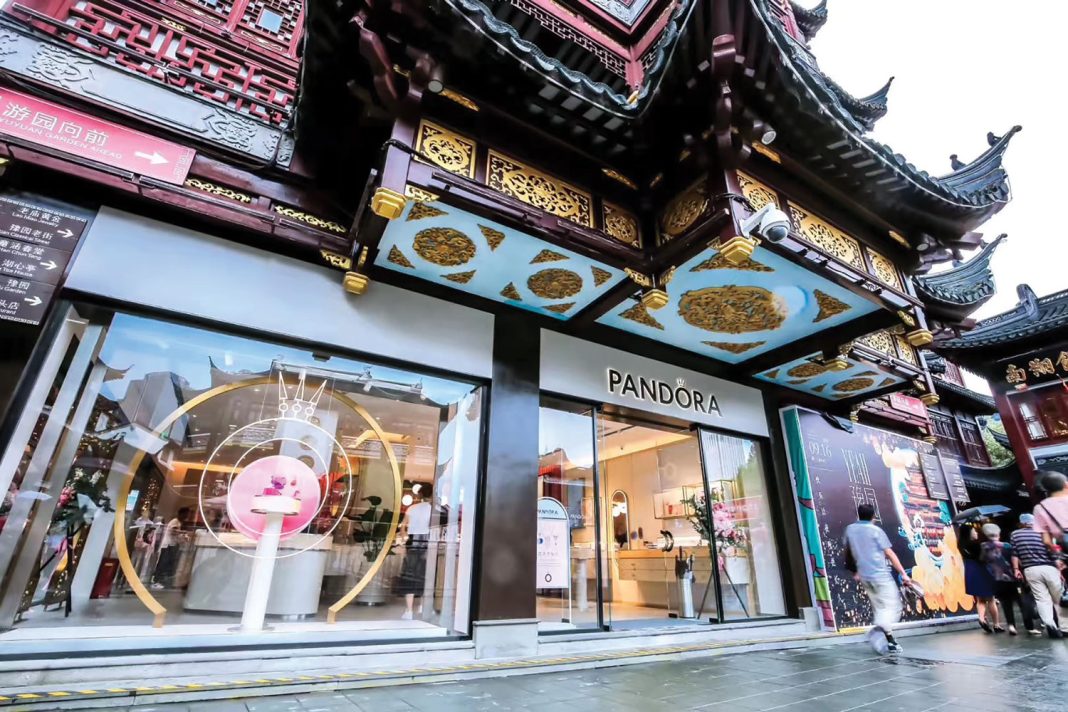

The world’s largest jewellery brand, Pandora, designs, manufactures and markets hand-finished jewellery that is created from high-quality, sustainable materials at affordable prices. In this interview, RLI sits down with the company CEO Alexander Lacik to discuss how the company continues to evolve its offering and grow its retail footprint.
Founded 40 years ago by Per and Winnie Enevoldsen, Pandora began life as a family-run jewellery shop in downtown Copenhagen. However it wasn’t until around the turn of the century and the birth of the Pandora Moments concept that the brand really took off and began growing into the global phenomenon that we know today.
The Pandora Moments concept centres around customers being able to build their own bracelets through a series of charms, meaning every guest can build a product that is unique to them and only them, offering a layer of personalisation that has led to worldwide success for the brand.
Today the business has 6,773 points of sale, with 2,619 of these being Pandora concept stores with the company owning 1,423 stores and the rest being mainly operated through franchise agreements or through distributor set-ups.
A global brand that operates in over 100 countries across six continents, its top seven markets are the US, where it has 348 sites, China and the UK both have over 200 stores and Italy, Germany, Australia and France are all home to over 100 stores. Aside from these main markets they also have a presence in such countries as Greece, Hong Kong, Japan, Macau, Netherlands, New Zealand, Norway, Singapore, South Korea, Spain, Sweden and Taiwan.

Leidschendam, Netherlands
“Looking forward, we feel there is plenty of space for us to grow in Latin America, along with the US where store density is still quite low,” says Alexander Lacik, CEO of Pandora. “Then in Asia, there are tremendous growth opportunities in China across not only tier-one cities, but tier-two and tier-three as well. Japan and India are also locations where we have a presence, but a presence we believe we can grow substantially in.”
The current CEO took the reins in 2019 and was tasked with building the brand and focusing on the brand experience. “In the seven to eight months I was in place before the pandemic hit, we undertook a program that comprised of four parts. The first was brand relevance and making Pandora relevant for customers again. Second was all about brand access and distribution. Next we concentrated on a cost reset to help fund points one and two and finally we conducted a commercial reset which was designed as a one-year program to streamline the business,” Lacik explains.
These programs had been building fresh traction for the brand and they had committed multiple investments in Q4 of 2019, but then came the beginnings of the noise from Wuhan about the virus. Faced with a choice, Lacik proceeded to move forward with these plans rather than shut up shop and wait it out, a decision which has been vindicated in the time since as the brand continues to grow and evolve with the times.

Per square metre of store space, Pandora is one of, if not the most profitable retailers in the world and their store portfolio has traditionally consisted of small, box-shaped shops of around 60sq m that are accentuated with glass and chrome.
Recently they have introduced a new store concept called Evoke, which is in its testing phase, and has been created to make shopping more intuitive for customers and improve the speed of service, allowing customers to seamlessly explore, find and try on products. To date, three of these new stores have opened, one in London, UK, one in Milan, Italy and the final one in Guangzhou, China.
“The idea behind these new stores is that they retain the high productivity of the previous stores whilst highlighting some aspects of omni-channel retailing and connecting the digital and the physical as well as expand the way we merchandise and highlight the rest of our offer as much as the Pandora Moments collection,” says Lacik.

Two new concepts that add to the offer outside of the Moments selection are the Pandora ME collection, which is targeted more towards Gen Z’s in its design, and the Brilliance collection of lab-created diamond jewellery which has recently launched in the UK aiming to make diamond jewellery affordable for a broader clientele.
In recent years the company has refocused its efforts across its social media platforms and e-commerce offer. Even with its incredible store portfolio, e-commerce is still the largest outlet in terms of traffic in any given country, so the brand has invested in promoting and highlighting this area of the business.
When it comes to the growing area in retail of sustainability, Pandora was actually ahead of the curve in this respect according to Lacik. “The founder of the business was already thinking about the sustainability before it became such a prominent factor. If you take a look at our manufacturing site in Thailand, it is the only LEED-certified plant in Asia where 100 per cent of their waste is reused, recycled or sold onto people who can use it.”

The retailer stands out from the crowd because of its singular brand proposition and because of its nature of co-creation. Jewellery from Pandora offers people the opportunity to design and create a bracelet, working together with in-store staff, which is unique, personalised and meaningful to them through their selection of over 1,000 different charms.
“It is a product that people cannot put a price on because it reflects the individual and is important to them. We feel this is the purpose of our company, to give a voice to people’s loves and offer them a chance to represent this on their wrists,” Lacik concludes.
