


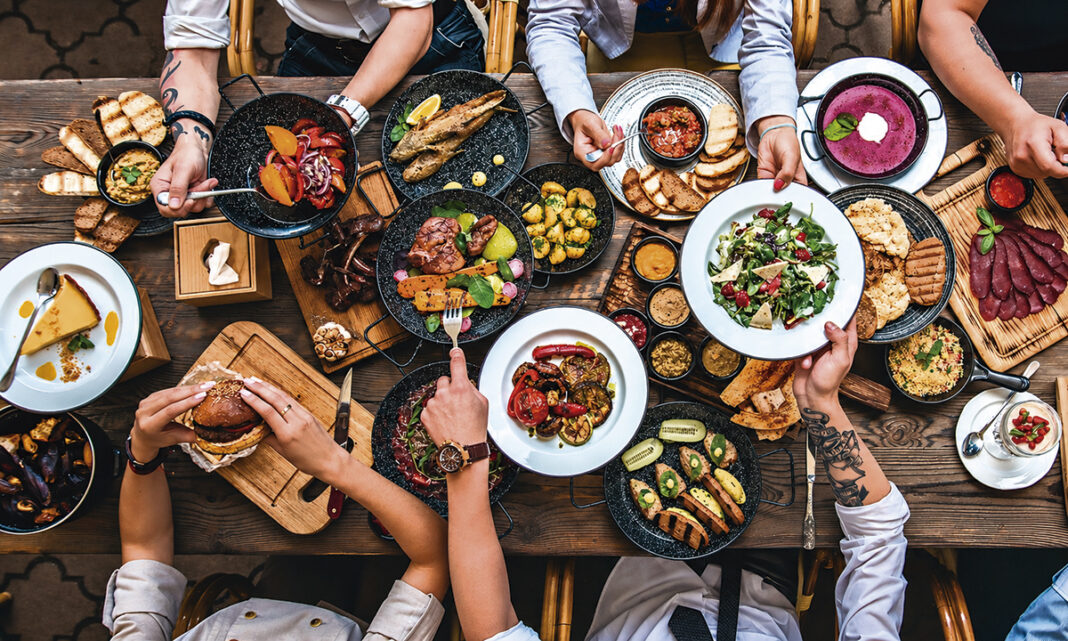
Jonathan Doughty is a global thought leader, consultant, speaker, moderator and C-suite executive in the foodservice and leisure sectors working around the world in retail, transit and leisure. In this issue’s column, he highlights the top industry trends of the year.

The global restaurant industry has entered 2026 facing an unusual combination of pressures and opportunities. Consumers remain enthusiastic about eating out, but they are more selective about where they spend their money. Operators face elevated labour, ingredient, utility and delivery costs while being asked to provide greater convenience, personalisation and value.
Emerging trends this year span culinary innovation, equipment, environmental responsibility and service, suggesting that 2026 is becoming a year of structural change for restaurants worldwide.
1. Wellness, Protein and the GLP-1 Effect
Perhaps the most consequential culinary development of 2026 is the evolution of “healthy eating” into something much more specific: nutrient-dense food, increased protein, smaller portions and less-processed ingredients.
Wellness-focused menu innovation is a major global foodservice trend, with GLP-1 weight-management drugs contributing to changing dietary requirements.
The customer base extends well beyond GLP-1 users. Health-conscious Millennials and Gen Z consumers, fitness-focused diners and older customers interested in maintaining muscle health can all find appeal in smaller, nutritionally substantial dishes.
2. Hyperlocal Food Goes Global
Global cuisine is hardly new. What is changing is the level of specificity diners now expect. Instead of generic “Asian”, “Latin” or “African” influences, restaurants are exploring identifiable regional dishes, ingredients and cooking traditions.
I have often described this as the emergence of “hyperlocal cooking”, which is a journey of discovery for so many, accelerated by digital discovery and social media. We are going into “hyper focus” on many menus, operations and units.
This particularly resonates with Gen Z and younger Millennials, whose culinary discovery increasingly crosses geographic boundaries through social platforms.
For chefs, the opportunity is enormous, but authenticity matters. Successful restaurants will increasingly tell customers where a dish or ingredient originates rather than simply borrowing an exotic flavour. Truth matters, especially on social…
3. AI and Targeted Automation in the Restaurant
2026 may ultimately be remembered as the year restaurant AI became less theoretical and more practical.
Automation is appearing in kitchens, ordering systems, inventory management and equipment controls. Process-specific automation and AI embedded directly into equipment rather than an industry-wide rush towards humanoid robots is a thing now.
Restaurants are also using AI to forecast stock requirements, reduce waste and simplify internal communication. The objective increasingly appears to be augmenting employees rather than eliminating hospitality: automate repetitive work so staff have more time for guests. I massively applaud that and genuinely believe that we will value “human service” more in the future.
Quick-service restaurants, large chains and institutional catering operations are obvious early beneficiaries because relatively small productivity improvements can become substantial at scale.
4. Sustainability Moves from Marketing to Operations
Sustainability has spent years appearing on restaurant trend lists. In 2026, however, its character is changing. The discussion is shifting away from aspirational messaging towards measurable operational improvements.
Food waste, energy consumption, packaging, sourcing and refrigeration are becoming business issues as much as environmental ones. Kitchen electrification is a big trend. Restaurants are experimenting with induction equipment partly to reduce emissions and energy consumption, but also because cooler kitchens can improve employee working conditions during increasingly hot summers.
5. Beverages Destinations in Their Own Right
Finally, 2026 is seeing restaurants rethink the humble drink. Specialist coffees, teas, functional beverages, refreshers, smoothies and sophisticated alcohol-free drinks are increasingly becoming reasons to visit rather than accessories to a meal.
Beverage-led concepts are a major growth area, driven particularly by Gen Z consumers seeking customisation, convenience, novelty and visually distinctive experiences. They do not need alcohol, but drinks are an increasingly powerful generator of daily traffic, new dayparts and higher guest spend.
A Restaurant Industry Being Redesigned
Taken together, 2026’s most important trends reveal something larger than changing tastes. Restaurants are being redesigned around healthier consumption, cultural curiosity, intelligent technology, environmental efficiency and more flexible dining occasions.
Successful operators will be those that recognise the deeper forces underneath these trends: customers want food that feels worthwhile, generous in experiences that remain distinctly human, greater freedom over how and when they consume and restaurants whose technology and environmental practices make the business more efficient and enjoyable.
