


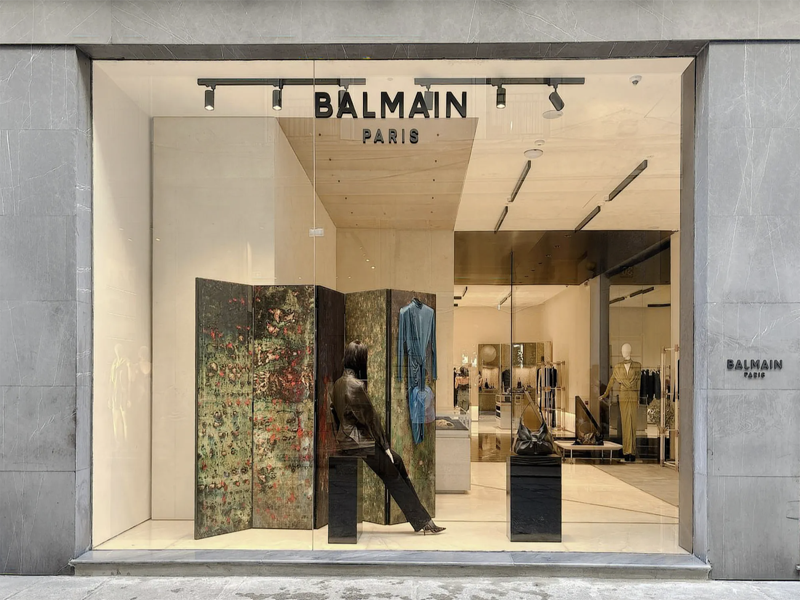
Balmain has opened its new flagship boutique in Milan at 23 Via della Spiga, in the heart of the city’s fashion district. Spanning 300 square metres across two floors, the new space does far more than simply showcase the house’s collections; it seeks to extend its universe through a close dialogue between fashion, architecture, and craftsmanship.
Initially conceived by architect Vincenzo De Cotiis, the boutique preserves several elements of its existing architecture rather than attempting to erase them. Under the artistic direction of Antonin Tron, appointed in late 2025 following Olivier Rousteing’s departure, and with interiors designed by architect Andrea Faraguna, the space adopts a design language that is both restrained and daring, where architectural heritage enters into dialogue with a more contemporary expression of the house.
This project builds on the work initiated for Balmain’s Autumn/Winter 2026 show, creating continuity between the world presented on the runway and the one offered to clients in-store. It also reflects a long-held conviction of the house: that architecture is an integral part of fashion’s language, in line with the vision of its founder, Pierre Balmain.
Inside, the space draws more on the vocabulary of a contemporary art gallery than on that of a traditional boutique. Onyx, Venetian stucco, metal, glass, fibreglass, and mirrored surfaces interact within a scenography where plays of light and reflection take centre stage. Certain traces of the original architecture have been deliberately preserved, lending the space a more singular character and making the passage of time an integral element of the décor. The furnishings further this approach with nods to craftsmanship – particularly Japanese – through work inspired by eggshell and materials such as curly shearling.
On the ground floor, womenswear and accessories are displayed in a bright, airy setting, marked by Art Deco influences and subtly reflective surfaces. The silhouettes are presented in an environment conceived as a jewellery box, with particular attention paid to proportions, materials, and the flow of movement through the space.
On the lower level, dedicated to menswear and accessories, the atmosphere becomes more intimate. The palette shifts to warmer tones, while mirrors and sculptural metallic elements structure the circulation, and a central volume changes as the visitor’s viewpoint shifts.
