

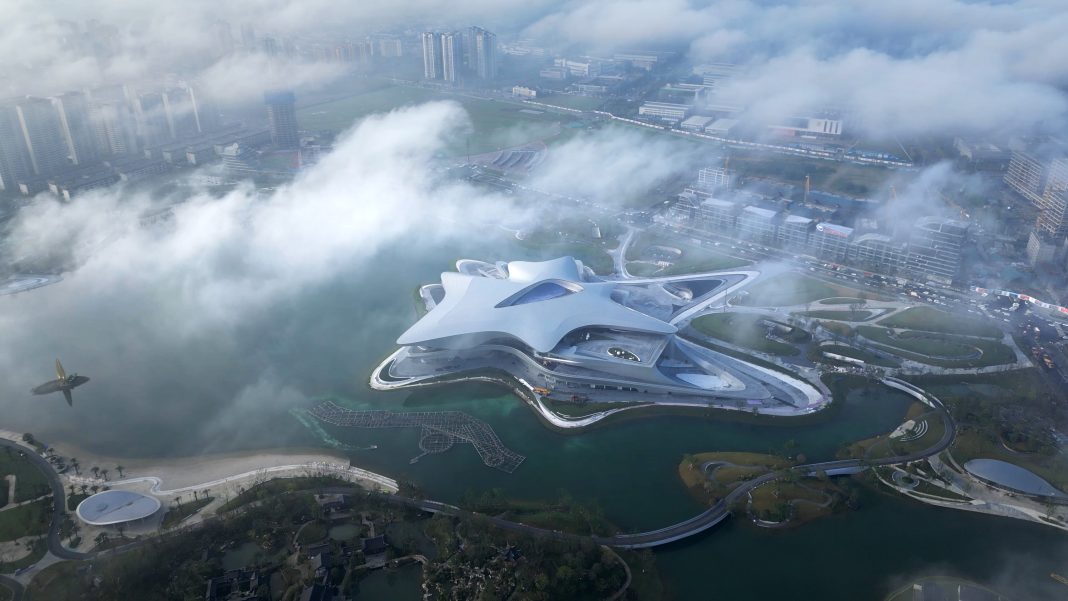
Showcasing the city’s contribution to the evolution of the science fiction genre and popularity around the world, the new Chengdu Science Fiction Museum has opened by hosting the World Science Fiction Convention (Worldcon) and Hugo Awards, the first time the events have been held in China.
Surrounded by mountain ranges and forests, the city of Chengdu has cultivated unique local traditions and culture rooted in its rich history that includes the celestial forms within the carvings and masks of the Bronze Age Sanxingdui civilisation. The capital of Sichuan province in Southwest China, Chengdu has grown to over 20 million residents as an important centre of scientific innovation and research.
At the core of Jingrong Lake, the new Chengdu Science Fiction Museum is within the Science & Innovation New City of Chengdu’s Pidu District. Integrating with the natural landscapes along the lakeshore, the museum’s design defines nodes of activity connected by pedestrian routes that extend from the city through the surrounding parkland into the heart of the building; creating a journey of discovery that weaves between indoor and outdoor plazas at multiple levels to link the museum’s exhibition galleries, educational facilities, cafes and other amenities.
Bringing together programmatic and functional clarity while responding to its unique site conditions, the museum appears to float above from the surface of the lake. The fluid forms of its roof radiate from a central point within, emulating an expanding nebula cloud with a star at its centre – transforming the museum into a ‘star cloud’ that disperses energy fields into its many different zones; guiding visitors through a portal that connects our lived experience with our imagination. Incorporating maximum flexibility to host the widest variety of exhibitions, conferences and events, the 59,000sq m Chengdu Science Fiction Museum includes exhibition galleries, a multi-function hall, a conference centre and supporting ancillary spaces. The sky-lit central atrium and its large window facing the spectacular Xiling Mountain connect the museum’s interiors with its surrounding environment.