

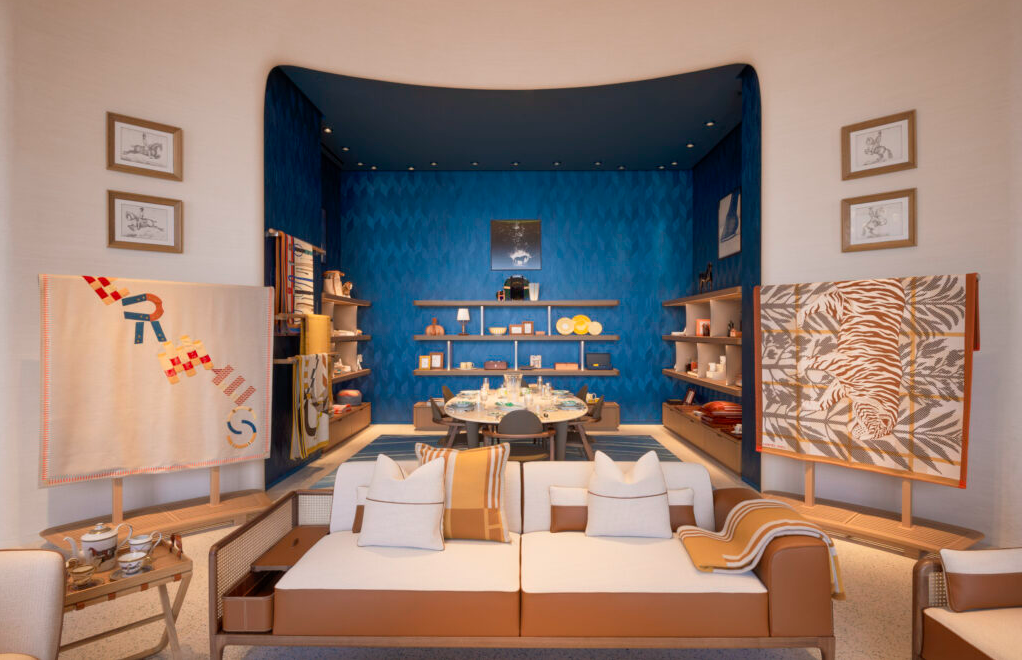
Hermes has opened a new store in Bahrain Marassi Galleria, a brand-new waterfront destination. The new openings marks the sixth store in the region which combines its familiar architecture with the unique backdrop of a vast desert landscape nestled between the sky and the sea. The house’s sixteen métiers unfold in the oasis-like setting with sandy hues and textural treatments.
The facade, reminiscent of a stone massif, features the curves and textured surfaces of weathered rocks. The single entrance leads into a spacious room showcasing women’s silk, with a display for fashion jewellery and men’s silk on one side and the perfume and beauty universe on the other.
In the center of the store, a domed ceiling soars above a circular salon flanked by niches and adorned with deep blue-green wallpaper – a backdrop for the jewellery and watches as well as the home universe. Further along the path, the salon is divided into the men’s and women’s universes, with leather goods at its heart.
Semi-transparent panels crafted locally from hand-woven and knotted macramé create intimacy for each métier while preserving the open, airy feeling of the layout. Envisioned by the Parisian architecture agency RDAI, the store’s design reflects the surrounding natural landscape. Both form and materials take inspiration from rock formations carved by the elements over many millennia.
The evocation of sand and water continues in the flooring through the milky blue and the beige terrazzo tiles of the Faubourg mosaic. Ring-shaped motifs reminiscent of wave ripples adorn the carpets, whose colours range from deep cerulean to earthy ochres. The store is further enlivened by a selection of artworks featuring equine silhouettes and naturalist illustrations.
From the Emile Hermès collection, majestic Arabian horses are brought to life in a series of sketches as well as in paintings by Horace Vernet. For the store opening, artist Faissal El-Malak’s artwork When the Guard Crosses the Street at Night animates the windows. The horse, inspired by the Faubourg’s balustrade, is transformed into a ribbon of ropes and gateways from which ladders emerge to allow the objects to flow between the different metiers.