

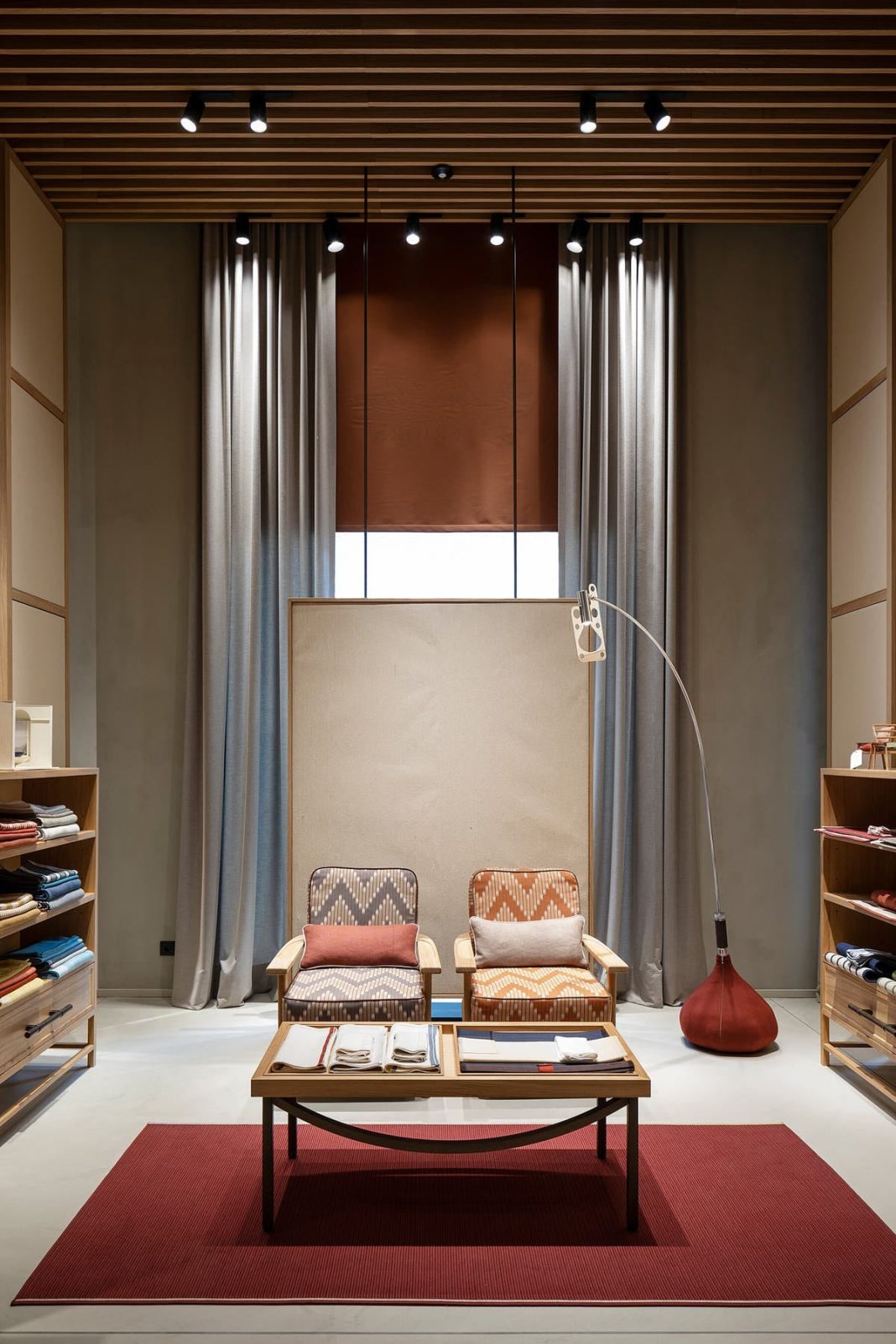
Loro Piana new store and headquarters are located in a heritage Milan building that was once the bustling center of the local silk trade. Loro Piana Interiors’s new store features customizable blankets made of cashmere, silk and wool blends, embroidered cashmere and wool throw pillows and a Palm Duet chaise longue designed by Raphael Navot and upholstered in Cashfur, a blend of cashmere and silk.
The imposing palazzo housing the new is strategically located at Via della Moscova 33 in Milan’s Brera district. Industrialists and artisans would travel from across Italy to the building, constructed in the late 19th century and known as the Cortile della Seta, to meet, trade and vote on industry matters.
During World War II, the structure was destroyed by bombs; it was later rebuilt and used as a bank. Originally from Trivero, in the northern Italian region of Piedmont, the Loro Piana family has been working in wool, an economic staple of the mountainous province, since the early 1800s.
Pietro Loro Piana founded the namesake brand, which quickly became known for producing some of the finest fabrics in Italy, in 1924. During the postwar years, the label developed a robust business selling to upscale tailors across Europe, the United States and Japan, but it wasn’t until the 1970s, when two of Pietro’s great-nephews, brothers Pier Luigi and Sergio Loro Piana, followed in the footsteps of their father, Franco, and took the helm that it began to resemble its current shape.
The pair introduced garments and accessories and looked beyond Piedmont for materials, including baby cashmere from Mongolia, obtained from the under-fleece of a baby Capra hircus goat that can only be combed out once in the kid’s lifetime, before it turns one, and vicuña (first sourced for the brand by Franco), which is derived from a relative of the llama from the Andes.By the late 1990s, Loro Piana was selling smart tailored jackets, wool overcoats and finely woven cashmere sweaters in its shops in Milan and New York.
In 2013, LVMH purchased an 80 percent stake in the brand (it purchased another 5 percent a few years later), though Pier Luigi remains as vice president. And it’s retained its reputation for exceptional and often exclusive materials, as well as for its dedication to craftsmanship: All stages of production, from the processing of fibers to the weaving of textiles to the sewing and finishing of garments and other goods, take place entirely in-house between nine factories or mills, all in Italy and most in Piedmont.
Its new location, Loro Piana seems to be turning the page to yet another new chapter. Previously, its offices were scattered throughout the city, but as the brand continued to grow, the decision was made to bring its design, marketing, administrative and other teams together to facilitate communication between them.When Via della Moscova 33 became available following a lengthy structural renovation led by the local firm Asti Architetti, its central location, size (280,000 square feet) and rich past made it an obvious choice.
The company commissioned Vincent Van Duysen, the Belgian architect known for such clean-lined projects as Casa M, his own minimalist concrete retreat that sits among the dunes in the seaside town of Comporta, Portugal, and Antwerp’s elegant August hotel, set in a former convent. Both the architect and the brand trade in a disarming sort of simplicity, whether in the form of a spare travertine-lined home or that of an unembellished merino knit.
Via della Moscova 33’s sun-drenched, glass-roofed internal courtyard, where tens of thousands of bundles of precious silkworm cocoons were once stored, now serves as a kind of town square for the brand. Standing at its center, one can peer skyward through the wide stacked windows and into various showrooms, where racks of garments stand against pale cream walls, and into airy offices.
The architect’s overall goal, he says, was to give the company’s employees a fresh environment while also referencing the brand’s DNA. The fluted walls on the second floor, for instance, are swathed in a cream-colored fabric made of Trevira, a flame-resistant technical material, while within the otherwise open-plan offices he devised a system of Trevira-covered partitions.
They sit tucked into custom desks, with bone-colored aluminum frames, pale oak drawers and dove gray felt privacy screens, that Van Duysen designed for Unifor. The flooring is made of recycled fishing nets.
It’s noteworthy that the new space is being inaugurated just as the company itself is beefing up its interiors division, which launched with decorative textiles, accessories and rugs in 2006. The company opened textile showrooms for design professionals in Milan, New York, Paris and Los Angeles.
But when Pergamo moved into interiors in 2019 — he had previously been the director of women’s and leather goods product development — he did so with the goal of making Loro Piana fabrics, and much else, more visible and accessible.Set behind four grand arched windows on the building’s street level, it was designed by the in-house team, and while the offices fully embrace Van Duysen’s strain of minimalism, the shop feels more like someone’s warm and well-appointed home.
The brand’s cashmere-upholstered furniture is arranged in several domestic mise-en-scènes (a dining and sitting area, a spalike bathroom) accented with products ranging from woven horsehair place mats to silk-cashmere dressing gowns.Also on offer are carpets and wall-coverings, and in a small alcove at the store’s rear, fabric samples hang on pegs in what is known as the textile library.
They’re organized according to color and include Chesa, a blend of cashmere and yarn-dyed wool in a muted gray and amber madras pattern, and Ice, a pure cashmere whose undyed fibers coalesce in a natural mélange. Customers can simply select their favorite, or work with the in-house design team, located on the store’s second floor.